31.7.08

proto thunder


Consubstantiality

Transubstantiation

Magnificand

Jew

BANG!

Wombed in sin darkness I was too made not begotten. . . . From before the ages He willed me and now may not will me away or ever. A lex eternal stays about Him. Is that then the divine substance wherein Father and Son are consubstantial? Where is poor dear Arius to try conclusions? Warring his life long upon the contransmagnificandjewbangtantiality. (p. 32)

sniffer


  • Microchips with antennas will be embedded in virtually everything you buy, wear, drive and read, allowing retailers and law enforcement to track consumer items -- and, by extension, consumers -- wherever they go, from a distance.
  • A seamless, global network of electronic "sniffers" will scan radio tags in myriad public settings, identifying people and their tastes instantly so that customized ads, "live spam" may be beamed at them.
  • In "Smart Homes," sensors built into walls, floors and appliances will inventory possessions, record eating habits, monitor medicine cabinets -- all the while, silently reporting data to marketers eager for a peek into the occupants' private lives.
  • LMA SOT OPG

    excellent CHEMICAL BODY recovery


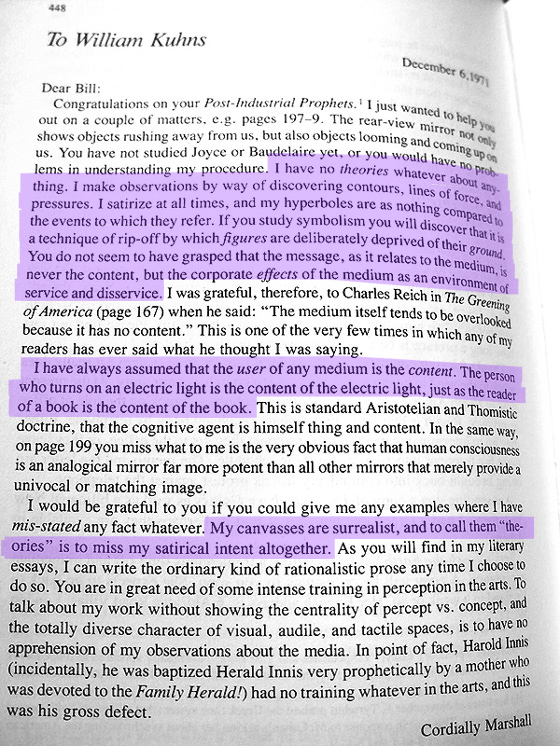
    Current mood: medium is the message

    thunder 45

    30.7.08

    did not match any documents

    5ive BOB bodied


    The Chemical Body is what most people consider to be their "physical body". The dominant model for this is the product of Western science since the telegraph.

    The Astral Body is what pervades all cultures - the belief there is more to our makeup than the Chemical Body. It is a huge storehouse of religious and spiritual
    energy.

    The TV Body is the repository of historical one-way broadcasting.

    The Chip Body is the mutating warehouse of digital omni-directional media.

    The Mystery Body is what we're still excavating and whose lineaments we cannot fully assess yet, if ever. We know it's made up of the previous four bodies but we don't know what more we will discover about its constituents, affects, and effects.


    29.7.08

    >hoicking up the anti ...


    RIGHT WINGER

    Rightfully, McLuhan can now be called "the last Victorian," for these messages to family, friends and colleagues clearly document his lifelong commitment to being a later Twentieth century man of letters, a contemporary equivalent of his youthful hero, G. K. Chesterton. He repeatedly suggests his bias is for print; his preferences,for the life of Oxford and Cambridge between the two wars; his motivation, the dislike of the new tribal world and its corporate actitivites. Unabashedly, he further documents Arther Kroker's (Kroker, 1984) and my claim (Theall, 1971) concerning the importance of his Catholicism by suggesting that his thought was metaphysical, that he was primarily a Thomist (though hardly one accepted by Thomist orthodoxy) and that, in spite of the stupidities of its bureaucracy, one can only live reasonably within the Catholic Church whose spiritual mission is triumphant. Consequently he expresses in his correspondence moral views which may appear contradictory when related to his writings: his condemnation of abortion, pornography and of frank, illustrated texts on sexual education for young children...

    This aspect of his Letters hardly presents the ultra-modem, futuristic, left-wing idol who dominated the media for nearly a decade as the prophet of the communication society. But the Letters also underline a schizophrenia which is central to understanding why McLuhan achieved what he did and made some of the most central contributions to dialogue concerning communication in our time. Balancing his Thomism is McLuhan's continuing use of Joyce's work, even though early in his career he had concluded that Joyce's work was demonic, for he says of the last page of Finnegans Wake and the opening of Ulysses: "the whole thing is an intellectural Black Mass .... As he (Joyce) reads it (Ulysses) ... it is horrible. Casual, eerie. Speaking of Existenz and the hatred of language--what about Finnegan" (183)? He tells a former student and colleague, Father Walter Ong, that the church has it all wrong with respect to Nietzsche:


    "God is dead (Nietzsche) equals: God has abandoned the work of grace in creation? Prelude to incarnation as understood in pagan cults? At least, so I hear from the inside boys. Catholic view of Neech [sic!] would seem to be a bit off the beam there".


    The whole of his achievement--in fact, his interest in communication--he attributes to Baudelaire, Mallarrme, Valery and other French Symbolists, but even more particularly to their English modernist and post-modernist successors, Yeats, Pound, Eliot and Joyce. In what could only be an indictment of many students of communication who have turned to McLuhan, he wrote in 1974 that: "Nobody could pretend serious interest in my work who is not completely familiar with all of the works of James Joyce and the French Symbolists" (505).

    - Don Theall : Messages in McLuhan's Letters


    and

    as Genosko points out, 'Ultimately, however, McLuhan's own corporatist assumptions, homophobia, and 'right-to-life' politics were read as the signs of a deeply conservative Catholic thinker.'


    McLuhan and Baudrillard: The Masters of Implosion

    and

    "McLuhan's political commitments, represented both by his rejection of the "national question" in Canada and by his participation, in depth, in the futurology of technological empire, are of direct consequence to his contributions to a master theory of communications. That McLuhan could find no moment of deviation between his civil humanism, founded on the defence of "civilization", and his absorption into the intellectual appendages of empire, indicates, starkly and dramatically, precisely how inert and uncritical is the supervening value of "civilization". McLuhan's lasting legacy is, perhaps, a historical one: the inherent contradiction of his discourse in remaining committed to the very technostructure which had destroyed the possibility of "civilization" indicates the ultimate failure of civil humanism in modern politics. McLuhan's humanism, and indeed his abiding Catholicism, could provide an inspiring vision of a more utopian human future; but in remaining tied to the "primacy of reason", a reason which was fully abstracted from history and ontology, McLuhan's discourse could always be easily turned from within. This was the comic aspect of the whole affair: the technological dynamo could also accept as its dominant value the "primacy of reason"; and, by extension, the application of technical reason, in politics, bureaucracy, science, and industry, to the proliferation of technological media. The technostructure thus absorbed McLuhan's discourse on his own terms: it transposed his search for a new, universal civilization into an historical justification of technological necessitarianism; and it showed precisely how compatible the Catholic conception of "transcendent reason" is with the rationalising impulses of the technological system. McLuhan's one possible avenue of escape: the recovery of a "grounded" and emergent cultural practice or, at least, some sense of "intimations of deprival" which had been silenced by the technological dynamo was, of course, firmly closed to him by his commitment to the universal over the local, and to the metaphorical over the historical. To dismiss McLuhan as a technological determinist is to miss entirely the point of his intellectual contribution. McLuhan's value as a theorist of culture and technology began just when he went over the hill to the side of the alien and surrealistic world of mass communications: the "real world" of technology where the nervous system is exteriorised and everyone is videoated daily like sitting screens for television. Just because McLuhan sought to see the real world of technology, and even to celebrate technological reason as freedom, he could provide such superb, first-hand accounts of the new society of electronic technologies. McLuhan was fated to be trapped in the deterministic world of technology, indeed to become one of the intellectual servomechanisms of the machine-world, because his Catholicism failed to provide him with an adequate cultural theory by which to escape the hegemony of the abstract media systems that he had sought to explore. Paradoxically, however, it was just when McLuhan became most cynical and most deterministic, when he became fully aware of the nightmarish quality of the "medium as massage", that his thought becomes most important as an entirely creative account of the great paradigm-shift now going on in twentieth-century experience. McLuhan was then, in the end, trapped in the "figure" of his own making. His discourse could provide a brilliant understanding of the inner functioning of the technological media; but no illumination concerning how "creative freedom" might be won through in the "age of anxiety, and dread." In a fully tragic sense, McLuhan's final legacy was this: he was the playful perpetrator, and then victim, of a sign-crime." - Arthur Kroker

    heuristic juxtaposition


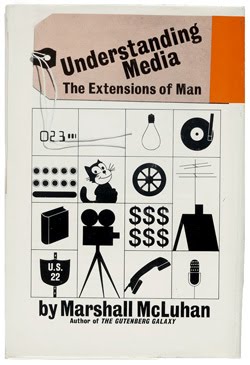
    "Juxtaposition functions as a heuristic, an invention strategy that has been used within the context of media and writing by Walter Benjamin in the Arcades project, William S. Burroughs and Bryon Gysin with the cut-up method, and McLuhan in Understanding Media. These writers used juxtaposition as a rhetorical device for creating associations and emotional responses out of the combination of unlike words and images, but they did so within the context of media."

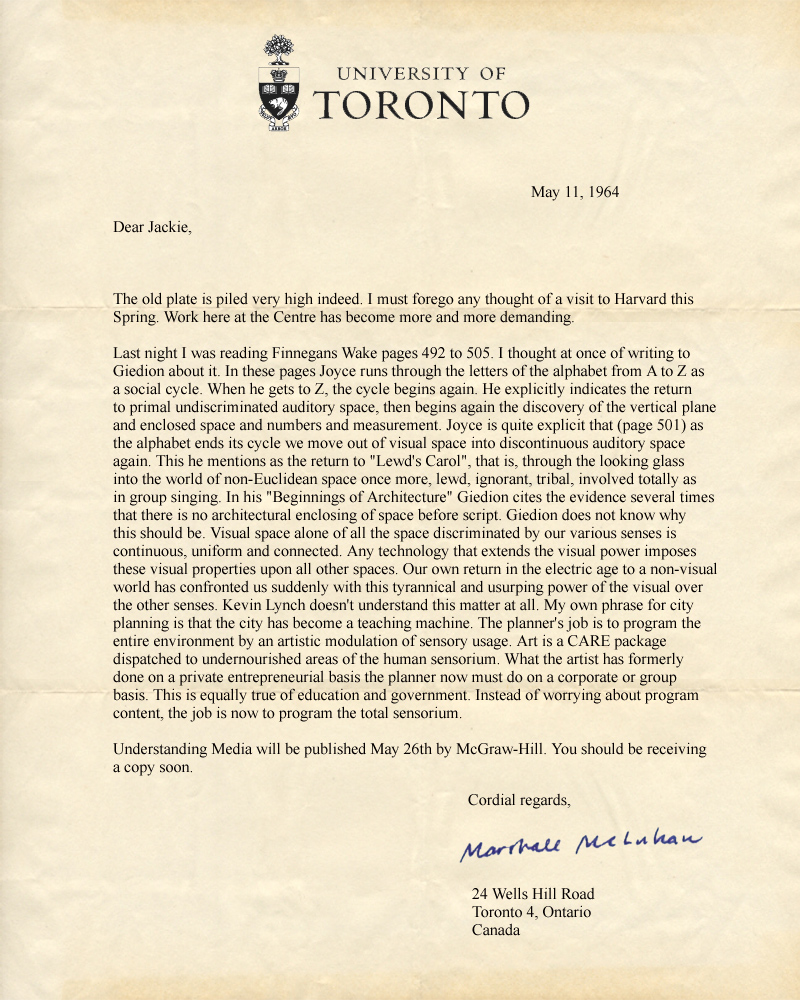
    a conceptual labyrinth at the speed of light


    "McLuhan drops Shannon and Weaver's focus on the mathematics of information, but at the same time follows the basic line of their argument by prioritizing analysis of the technology of message transmission over interpretation of its content (a move most media analysis is still reluctant to make today; see Kittler, 1996b). In this way, McLuhan's famous declaration that the 'medium is the message' develops the thinking of Shannon and Weaver (for whom there is no real message, only a signal, see Hayles, 1999: 18) by asserting the role of the channel (which Weaver also calls a medium) in shaping the content of what is transmitted (rather than vice versa). It is this transformative power which, for McLuhan, is the real message of technology: 'the "message" of any medium or technology is the change ofscale or pace or pattern that it introduces into human affairs' (1964: 8). But McLuhan also gives Shannon and Weaver's communication system a further twist, for the information source (the sender) and final destination of communication are dropped from his account."


    dark hero


    "[I]n the summer of 1950, Donald Theall, a young American graduate student at the university of Toronto, introduced his English professor, Marshall McLuhan, to Wiener's work and to the new thinking of the cybernetics group. Theall handed McLuhan copies of Cybernetics and The Human use of Human Beings and witnessed McLuhan's reaction. 'The relevance of Wiener in McLuhan's mind had to do with Wiener's image of the communications network as the contemporary image for the 'age of communications and control,' Theall recalled. Wiener's ideas stimulated McLuhan's thinking and spurred him on to build 'a foundation for a contemporary theory of artistic communication' that became a conduit for the flow of cybernetic ideas into art, literature, and the whole of popular culture."

    “Cyber” is from the Greek word for navigator. Norbert Wiener coined “cybernetics” around 1948 to denote the study of “teleological mechanisms” [systems that embody goals].

    The term itself began its rise to popularity in 1947 when Norbert Wiener used it to name a discipline apart from, but touching upon, such established disciplines as electrical engineering, mathematics, biology, neurophysiology, anthropology, and psychology. Wiener, Arturo Rosenblueth, and Julian Bigelow needed a name for their new discipline, and they adapted a Greek word meaning "the art of steering" to evoke the rich interaction of goals, predictions, actions, feedback, and response in systems of all kinds (the term "governor" derives from the same root) [Wiener 1948]. Early applications in the control of physical systems (aiming artillery, designing electrical circuits, and maneuvering simple robots) clarified the fundamental roles of these concepts in engineering; but the relevance to social systems and the softer sciences was also clear from the start. Many researchers from the 1940s through 1960 worked solidly within the tradition of cybernetics without necessarily using the term, some likely (R. Buckminster Fuller) but many less obviously (Gregory Bateson, Margaret Mead).


    re: Web 2.0 ... The Machine is Us/ing Us

    28.7.08

    Open Mind Surgery


    Now 'living at the speed of light' [the title of an earlier talk in 1974], there is no foreseeable future. You are there literally" (p. 293). One entire talk, delivered at Columbia University in 1973, "Art as Survival in the Electric Age," is devoted to demonstrating how in the instantaneous post-electric world the artist alone can provide the insight and knowledge to survive while living at the speed of the computerized world.

    In this talk McLuhan reiterates his total commitment, clear from the time of The Mechanical Bride onwards, that it is the artists, musicians, and poets and later the major artists of the popular arts, who are his guides and the only guides who are 50 years ahead of their time, who can provide guidance and the requisite vision. The tradition of those artists, says McLuhan, we now know occupied a major role in the prehistory of contemporary digiculture, beginning with Poe and Baudelaire, involving Rimbaud and Picasso, and continuing in the work of Yeats, Pound, and Eliot. McLuhan concludes by noting "that the job of the artist is to upset all the senses, and to provide new vision and new powers of adjusting and relating to new situations" (p. 223). In almost all of these talks artists appear as guides to understanding media - such as Marcel Duchamp, Wyndham Lewis, and James Joyce. It is clear the one with whom McLuhan felt the closest affinity was Wyndham Lewis, as he indicates in a talk on "Technology, Media and Culture" (1960) when he suggests that Lewis' uniqueness and thoroughness as historian and critic of the period means he is the most complete guide to the arts and letters of his age, providing the crucial critique of the avant-garde's flight from visual values and their embracing of popular culture as illustrated from Duchamp to Joyce (p. 16).

    For the vision that McLuhan feels is essential to "surviving at the speed of light," Joyce is the critical figure in a talk on "Open Mind Surgery" (1967). McLuhan notes that Joyce "called TV as X-Ray 'the charge of the light barricade' which is just one of a multitude of insights that makes Finnegans Wake . . . the greatest guide to the media ever devised on this planet, and . . . a tremendous study of the action of all media upon the human psyche and sensorium" (p. 152). Thus McLuhan's talks are largely a kind of aphoristic prose-poetry advancing artistic insights into the tremendous transformation of human perception through the emergence first of TV and then of computerization and worldwide electronic communication from the 1940s, when he wrote The Mechanical Bride, until 1979, when he delivered his last recorded talk.

    speed of bob light


    All news is fantasy at the speed of light, McLuhan said.

    Any information, including the dollar bill, acquires infinite mass at
    E=MC2.

    Now that we're bigger than the "media", the translation above is
    annulled at the disorienting SQUARED speed of thought.